
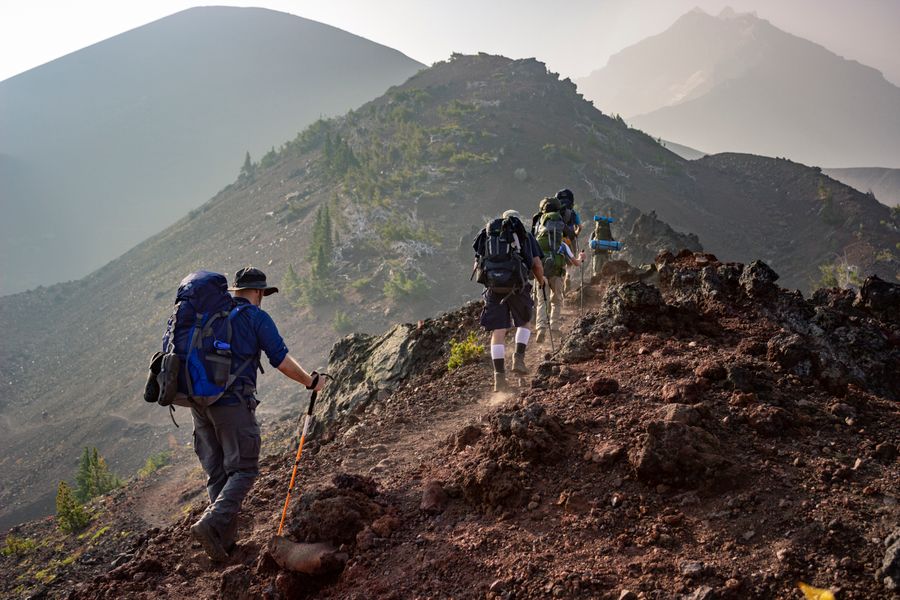
Climb Overview
The Marangu Route — often called the Coca-Cola Route — is the only route on Kilimanjaro that uses permanent hut accommodation instead of tents. That makes it the most comfortable option on the mountain, and a good starting point for first-time Kilimanjaro climbers. The 6-day version includes an extra acclimatisation day at Horombo Hut, which meaningfully improves your chances of reaching Uhuru Peak at 5,895m.
The route approaches the summit from the southeast, passing through rainforest, heathland, moorland and high-altitude desert before the final push across the lunar saddle to Kibo Hut. The midnight summit attempt is the hardest part — cold, slow and breathless — but standing on the roof of Africa at sunrise is something most people remember for the rest of their lives.
All climbs include a professional lead guide, assistant guides, mountain cooks and porters. Your team is with you every step of the way, and safety checks including daily health monitoring are carried out throughout the climb.
Best Time to Climb
January to March is a popular dry season window. Skies are often clear, temperatures are cold but manageable and the mountain is busy with climbers.
June to October is the main climbing season and generally considered the best overall. Dry conditions, good visibility and relatively stable weather make this the most reliable window for summit success.
April to May is the long rainy season. The mountain is quieter but trails are muddy and cloud cover is frequent. It is still possible to climb, but conditions are harder.
November brings short rains. Similar to the long rains, with wet conditions and lower visibility at altitude. Some climbers go in November and have a great experience — it is just less predictable.
Ecosystems & Terrain You'll Pass Through
Lower Zones
- ✓ Tropical rainforest
- ✓ Heathland
- ✓ Blue monkeys
- ✓ Giant heathers
Mid Zones
- ✓ Open moorland
- ✓ Giant groundsel
- ✓ Mawenzi peak views
- ✓ Zebra Rocks
Upper Zones
- ✓ Alpine desert
- ✓ The Saddle
- ✓ Glaciers & crater rim
- ✓ Uhuru Peak 5,895m
Day-by-Day Itinerary
Arrival in Moshi — Briefing & Gear Check
Arrive at Kilimanjaro International Airport and transfer to your hotel in Moshi. In the evening your lead guide meets you for a full briefing — covering the route, daily schedule, altitude safety and what to expect on summit night. This is also when your gear is checked; if anything is missing, rentals are available in town.
Marangu Gate (1,860m) → Mandara Hut (2,720m)
After breakfast you drive to Marangu Gate to complete park registration. The hike begins immediately in dense tropical rainforest — tall trees, bird calls and the occasional blue monkey overhead. The trail is well marked and the gradient is gentle. You arrive at Mandara Hut in the early afternoon with time to rest and explore the area before dinner.
Mandara Hut (2,720m) → Horombo Hut (3,720m)
The forest gives way to open heathland and then moorland as you gain altitude. The views open up and on a clear day you can see both Kibo and Mawenzi peaks. Giant heathers and unusual highland plants line the trail. It is a longer day than Day 2 but the scenery keeps things interesting. You reach Horombo Hut in the afternoon.
Acclimatisation Day at Horombo — Zebra Rocks Walk
This is the day that sets the 6-day itinerary apart. You stay at Horombo and let your body adjust to the altitude before going higher. In the morning, your guide takes you on a walk to Zebra Rocks — striking black-and-white striped lava formations at around 3,950m — with views across to Mawenzi and down over the moorland. You return to the hut for lunch and spend the afternoon resting. Eat well, drink plenty of water and sleep as much as you can.
Horombo Hut (3,720m) → Kibo Hut (4,703m)
The vegetation disappears almost entirely as you cross the high-altitude desert of the Saddle — the wide plateau connecting Mawenzi and Kibo. The landscape here is stark and lunar. The air gets noticeably thinner. Pace yourself and keep drinking water. You arrive at Kibo Hut in the afternoon, have an early dinner and go to bed as early as possible. The summit attempt starts around midnight.
Preparing for Summit Night
- ✓ Eat dinner even if you're not hungry — you need the energy
- ✓ Lay out all your summit layers before sleeping — you won't want to search in the dark at midnight
- ✓ Fill your water bottles and keep them inside your sleeping bag — water freezes quickly above 4,700m
- ✓ Sleep with your boots inside your bag if they're wet — frozen boots at midnight are miserable
Midnight Summit Push → Uhuru Peak (5,895m) → Horombo Hut
You wake around midnight, dress in all your summit layers and head out into the dark. The climb from Kibo Hut to the crater rim at Gilman's Point (5,681m) takes 4 to 6 hours of slow, steady uphill on scree. It is cold, the air is thin and the pace is very slow — that is exactly how it should be. Follow your guide, breathe steadily and keep moving.
From Gilman's Point you follow the crater rim for another hour to Uhuru Peak at 5,895m. Sunrise often hits just as you arrive. Sign the summit book, take your photos and take a moment to absorb where you are — the highest point in Africa.
The descent back to Kibo Hut takes around 2 to 3 hours. After a rest and some food, you continue all the way down to Horombo Hut for the night. It is a long day — typically 12 to 16 hours — but finishing at Horombo rather than descending to the gate means you have a proper meal and a bed.
Horombo Hut → Marangu Gate → Moshi
After breakfast you descend through the moorland and back into the rainforest, stopping for lunch at Mandara Hut. The final stretch brings you to Marangu Gate where your guide collects your summit certificate — a KINAPA-issued certificate confirming you reached Uhuru Peak. Your driver meets you at the gate and transfers you back to your hotel in Moshi for a hot shower and a celebration.
After the Climb — Add a Safari
Many climbers combine Kilimanjaro with a Tanzania safari. After the climb, your legs will need a day or two of rest — and there is no better way to recover than watching wildlife from a safari vehicle. We can arrange a Serengeti and Ngorongoro Crater safari, an Amboseli safari over the border in Kenya or a few days on Zanzibar to finish. Let us know when you enquire and we will build a combined package for you.
What's Included & Excluded
Included
- Airport transfers and hotel pickup / drop-off
- 1 night hotel in Moshi (pre-climb)
- 5 nights mountain hut accommodation
- All meals on the mountain — full board
- Kilimanjaro National Park fees
- Rescue fee (mandatory KINAPA levy)
- Professional lead guide & assistant guides
- Mountain cook & porters
- Daily health checks & pulse oximeter monitoring
- Emergency supplemental oxygen on the mountain
- Summit certificate (KINAPA)
- Bottled drinking water daily
- 24/7 support from Wild Safaris & Travel
Not Included
- International flights
- Tanzania tourist visa
- Travel & medical insurance (mandatory)
- Gear rental (available in Moshi)
- Tips for guides, cooks & porters (expected)
- Alcoholic & premium beverages
- Personal expenses & souvenirs
- Post-climb hotel accommodation
Frequently Asked Questions
The extra acclimatisation day at Horombo Hut gives your body more time to adjust before going above 4,000m. This directly improves summit success rates and reduces the risk of altitude sickness. We always recommend 6 days over 5 on the Marangu Route.
It is the only route on Kilimanjaro with permanent hut accommodation — you sleep in dormitory-style huts at Mandara, Horombo and Kibo rather than tents. This makes it warmer, drier and more sheltered. It also uses the same path for ascent and descent, which is less scenic than other routes but logistically simple.
The trail itself is well maintained with a gradual gradient, but the altitude makes every Kilimanjaro climb genuinely challenging. You need to be comfortable walking 5 to 8 hours a day and in reasonable physical condition. The summit night in particular is cold, exhausting and oxygen-thin — preparation and mindset matter as much as fitness.
The 6-day Marangu itinerary has a success rate of approximately 70 to 75 percent. The acclimatisation day makes a meaningful difference compared to 5-day versions. Our team's success rates are above the route average thanks to careful pacing and daily health monitoring.
Key items include a down jacket, waterproof outer shell, warm gloves, balaclava, thermal base layers, sturdy hiking boots and trekking poles. A full kit list is sent to all clients after booking. Gear rental is available in Moshi for items you do not already own.
Yes — it affects climbers of all fitness levels and cannot be fully predicted in advance. The best prevention is going slowly, staying well hydrated and not pushing through serious symptoms. Our guides carry emergency oxygen and are trained in altitude illness recognition. If you need to descend, we descend.
Most nationalities need a Tanzania tourist visa, which can be applied for online through the Tanzania e-visa portal before travel. We guide all clients through the process after booking.